CHAPTER 1 — THE SEED AND THE SOIL
The light was wrong.
It wasn’t the gentle gold of dawn, nor the harsh white of noon. It was a flat, even illumination, like the inside of a vast, clean room. Anthony Perlas opened his eyes to a sky of sterile blue, and the weight of a hundred souls crushed the air from his lungs before he took his first breath.
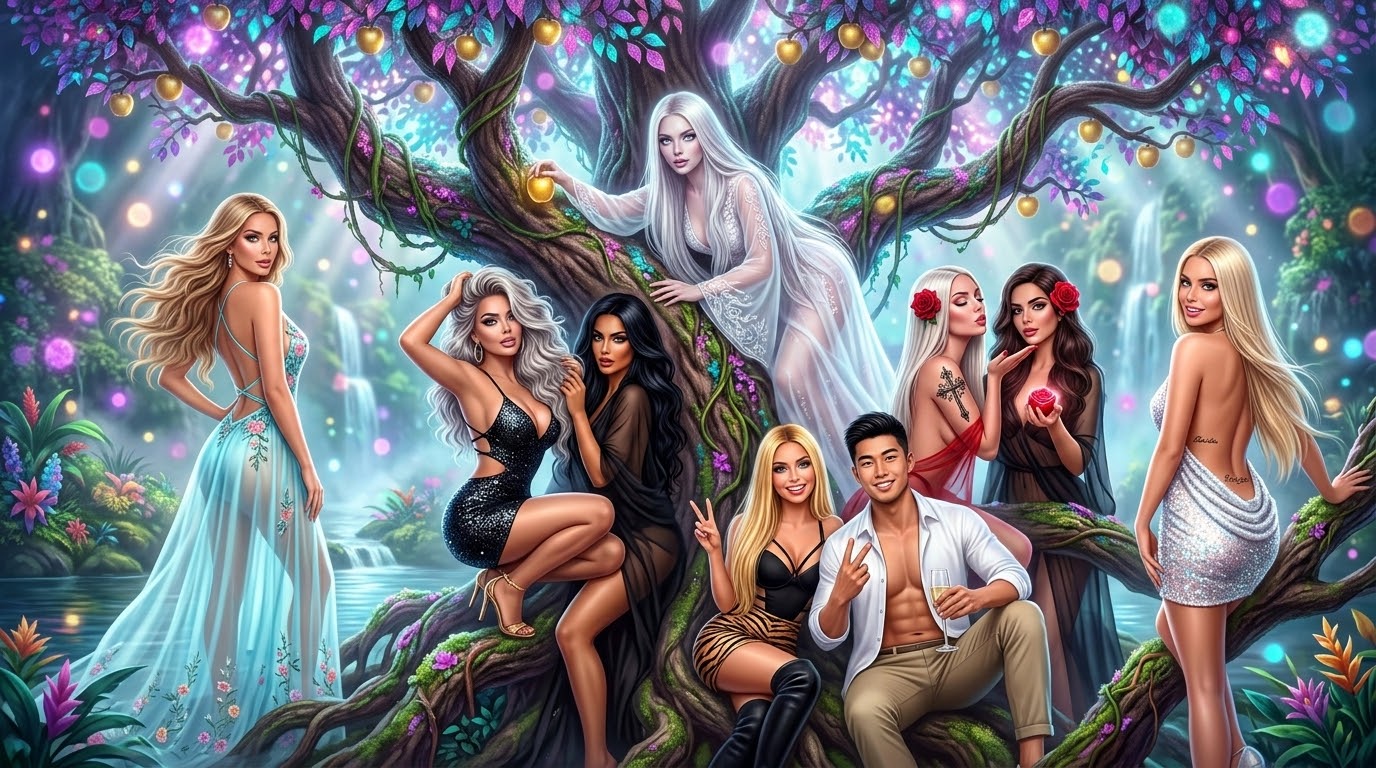
They lay around him in a perfect circle of soft, alien grass, one hundred and one young women, all eighteen years old. They slept with a uniformity that was unnerving—a field of identical blooms. He knew their number. He knew his own name. He knew, with a cold, implanted certainty, his purpose.
He was thirty-six. He was the only man. He was the seed.
Memory was a ghost. Flashes of a different world—stone walls, incense, the cadence of Latin, the weight of a different kind of collar. Dominus vobiscum. The Lord be with you. It was drowned under the immediate, screaming reality: one man, one hundred and one women, and a directive as old as time itself. Multiply.
He stood. His body was his own—the dense, powerful frame of a lifelong athlete, a wrestler’s build. He looked at them as they began to stir. A catalog of faces, each strikingly beautiful, yet each uniquely hardened by something not yet remembered. They were not girls. They were women, full-grown, with eyes that held unspoken histories.
The first to rise did so with a predator’s grace. She had dark hair tied sharply back, eyes like chips of obsidian, and a stillness that spoke of controlled violence. She looked at him, at his beard, at his solitary masculinity, and her gaze held no fear, only assessment.
“Where are we?” Her voice was low, clipped.
“I don’t know,” Anthony answered, his own voice rough from disuse.
“You are the only male.”
“Yes.”
“Why?”
The question hung there, the core of the terrible equation. He had no answer.
More were awake now. Whispers became a clamor. Panic flashed across faces, was wrestled down by others. A tall blonde with the bearing of a general was already on her feet, scanning the horizon, her mind visibly working. A redhead with fierce green eyes clutched at her own arms, rocking slightly. A brunette with gentle features immediately moved to comfort her.
Anthony raised a hand. Not a plea, but a command forged in a different fire. The silence that fell was immediate, charged.
“My name is Anthony Perlas,” he said, the name a blade cutting through the chaos. “We have been placed here. The purpose is survival. The rules are the rules of earth and blood. I will lead you.”
The dark-haired woman—he would learn her name was Kaia—did not look away. “By what right?”
He bent, picked up a smooth, heavy stone from the riverbank. He held it up. “By the right of the first tool.” His eyes swept over them, a general surveying his army of one. “And the second is your will to live. We need water, shelter, fire, food. You will organize. Step forward if you know plants. Step forward if you are not afraid of blood. Step forward if you can keep count.”
A woman with sharp, intelligent features and a gaze that missed nothing stepped forward. “I can keep count.” Her name was Selene. She began pointing, her voice calm and clear, numbering them off. One hundred and one. Plus one.
The tall blonde, Thora, stepped forward. “I understand structure. I can build.”
The gentle brunette, Elara, stood. “I… I know healing. I remember herbs.”
The redhead, Lyra, her fear transmuted into a fiery intensity, declared, “I know the sacred. I know the patterns of meaning.”
Others emerged. Freya, with restless, scanning eyes, a scout. Astra, whose very posture promised violence, a warrior. Iona, whose face spoke of empathy and negotiation. They were archetypes, slotted into place by a design he could not see.
But there were others, whose names came with a strange, resonant weight, as if they belonged to a story already written.
Kennedi, with watchful, calculating eyes. Emma Rosson, whose beauty was cold and precise. Kristina, who observed from the edges.
Destiny Adams, who stood with the quiet readiness of a soldier. Julia Whittman, whose fingers twitched as if writing in the air.
Emilyne Bialys, whose gaze held a deep, unsettling need. Skyhe Velarde, all sharp angles and defiance. Kallista Ganz Ohaire, whose presence seemed to draw the very light. Malibu, who looked at the sky as if expecting a sign.
And others—Kallista again, older in bearing somehow; Emilyne, now with a layer of hardened sorrow; Emma Rosson, etched with new authority; Destiny Adams, a pillar of grim resolve. They were echoes of themselves, generations superimposed on the present moment.
The first days were a brutal taxonomy of skill and will. Kaia and her nascent hunters—including Destiny Adams—fashioned spears from saplings hardened in the fire Thora built. Their first kill was a docile, confused goat. The blood on the green grass was a shocking sacrament.
That first night, gathered around the flame, Lyra began to speak. Not of practical things, but of the Four Rivers that converged in the distance, of the Valley of Wombs, of the Seed-Bringer who walked among them. She wove a myth to contain their terror, and her eyes, when they found Anthony’s, held not reverence, but a claiming. She was building his divinity, brick by sacred brick.
Elara approached him as the moon rose. “Their cycles are aligned,” she said, her voice devoid of emotion, a doctor reporting facts. “The statistical window for optimal conception is now. We need a schedule.”
The word was a door closing. Schedule. It reduced the act to logistics, to biology. It was correct. It felt like a damnation.
“I know,” he said, the weight of it settling into his bones.
“I will manage it,” she said, finally meeting his eyes. Hers were full of a painful, pragmatic understanding. “To maximize chances. To… conserve you. Your body is our most vital resource.”
Thora built it away from the main camp: a small, sturdy hut. The Seed Hut. It was bare, functional.
The first on the schedule was Cora, a woman with soft eyes and a tremble in her hands. The act was swift, impersonal, a transaction of survival. She left without a word. Anthony lay in the dark, the smell of her and the crushed grass filling the hut, and felt something within him calcify. This was the work. This was the first prayer of a new, brutal liturgy.
The rhythm began. Matins: first light. Prime: labor. Sext: the meager meal. None: more labor. Vespers: Lyra’s rituals, her voice spinning comfort and control from thin air. Compline: the schedule.
Anthony moved through it as the central pillar, the fixed point. He taught, he judged, he led. And at night, in the hut, he performed the duty. With Mira, who was all gentle patience. With Astra, who was a challenge met and conquered. With others whose names blurred into a procession of warmth and sigh and momentary connection that only deepened the isolation afterward.
Factions crystallized with shocking speed. The Loyalists: Kaia, Thora, Astra, Mira. They saw his leadership as the anchor of survival. The Challengers: Selene, Lyra, Freya. They saw the structure as a starting point for their own power—through data, through faith, through exploration. The Neutrals: Elara, Iona, and many others who worked and watched.
And then there were the others, the ones whose names carried that strange echo. Emma Rosson aligned with Selene, her cold logic a perfect fit. Kennedi watched from the shadows, her loyalty uncertain. Kristina worked with Elara, hands steady with herbs. Destiny Adams stood with Kaia, a natural warrior. Julia Whittman began making marks on bark, recording things.
Emilyne Bialys sought him out not during the schedule, but after a meal. Her need was a palpable thing. “I just… need to know I’m seen,” she whispered, and the transaction felt different, more dangerous. Skyhe Velarde challenged him openly at the fire about resource allocation, her eyes flashing. Kallista Ganz Ohaire attended Lyra’s rituals with a fervent intensity, absorbing the mystic’s every word. Malibu simply watched the stars, as if waiting for a signal.
The first pregnancy was announced by Elara barely three weeks later. It was Cora. The change was instant. A proud, defiant light entered her eyes. She gathered the other pregnant women—there were soon five—into a circle. They called themselves the First Wombs. A new hierarchy was born.
Astra, the warrior, spat into the fire. “They contribute nothing but swelling. They think it makes them special.”
“It does make them special,” Anthony said, the truth bitter on his tongue. “It’s the entire point.”
“The point is survival,” Astra countered. “A strong arm survives. A swollen belly… sometimes does not.”
Her words became a dark prophecy. Elara came to him one night, her face pale. It was Bree, one of the First Wombs. Labor had come too soon. Something was wrong.
The sounds from the birthing hut were not of life, but of a slow, grinding stop. Then silence.
Elara emerged, her hands and apron stained dark. “The child was breech. It would not turn. Both are gone.”
Death had entered Eden not from the wild, but from within their own flesh. The myth Lyra was building shattered on the rocks of a corpse.
Lyra’s mourning chant was a raw, torn thing. The other pregnant women clung together, their faces masks of terror. Selene’s expression was granite, already calculating the genetic loss.
Anthony walked to the central fire. The tribe gathered, their faces hollow in the flame-light. “We bury them at dawn,” he announced, his voice the flat of a blade. “We mourn. And then we continue.” He looked at Selene. “The schedule continues.” He looked at Lyra. “The rituals continue.” He looked at his hands, stained with the day’s labor. “This is the work. It is not clean. It is not kind. It is blood and soil and failure. And we will do it anyway.”
He did not go to the Seed Hut. He walked to the river, stripped, and waded into the black, cold water. He let the current pull at him, a fleeting fantasy of purification. Mea culpa, mea culpa, mea maxima culpa. My fault, my fault, my most grievous fault.
A presence on the bank. He turned. It was Freya, the scout, her eyes wide in the moonlight. In her hand, she held a smooth stone. It glowed from within with a soft, blue, impossible light.
“I found this,” she whispered. “North. In a cave. There are… markings. Not made by any hand I know.”
He climbed out, took the stone. It was warm, vibrating with a low, sub-aural hum. The markings were geometric, perfect, alien.
A key. Or a lock.
“Show me,” he said.
The garden had just revealed its first secret. And the cage, for the first time, had bars you could see.